The triple filtration in the Biofilter
- Filtration 1: Pre-filtration: Spunbond (made with thermally welded filaments, 100% polypropylene) mixed with fibers. Sediment filter which retains particles of iron, sand, mud, neutralizes the development of germs, bacteria etc … and protects the activated carbon block
- Filtration 2: the Carbon Fiber Block (patent no. 2282494) is composed of activated carbon in sintered granules (porosity 20 µm) mixed with fibers. Activated carbon is obtained after calcination of coconut shells (increases the number of micropores) by injection of pressurized hot water vapor (activation of the carbon by different temperature levels of 900°C-1,000°C for several hours; activated carbon is regenerated by oxidation Chemical filtration of chlorine, nitrates, nitrites, organic pesticides and herbicides, tastes and odors
- the activated carbon physically retains pollutants in its structure up to diameters of 5 µm (physical filtration of heavy metals: lead, aluminum, bacteria, arsenic and parasites) ; (patent n° 2429067)
- Filtration 3: Aqualen fiber (patents n° 20704036 & US n° 6514413) ; fiber with a fiber diameter of 10 µm, mixed with activated carbon. This fiber resembles the roots of a tree which bind the granules of activated carbon into a dense structure. Its function is threefold, it:
- allows you to have a very large adsorption surface, that is to say a good distribution of water over the entire surface of the activated carbon (this avoids preferential water channels)
- incorporates in its structure ionized silver which is bactericidal (neutralizes microorganisms, antibiotics, drugs etc…), the silver is therefore not mixed with the activated carbon but retained in the microfiber ; (patent n° 2172720)


Activated carbon functions like a selective molecular magnet through adsorption:
- Non-polar or weakly polarized, pollutants insoluble in water (hydrophobic) —such as heavy metals, organic pesticides, chlorine, PFAS, pharmaceutical residues, and hormones—”adhere” to the neutral (non-polar, electrically uncharged) walls of the activated carbon’s micropores. This occurs thanks to chemical and physical attractive forces known as Van der Waals forces (weak attractive forces). Consequently, the activated carbon acts as a “magnet” for these pollutants (based on the principle that “like attracts like”).
- Polar minerals (calcium, magnesium, sodium)—which carry an electrical charge (positive or negative), are water-soluble, and are therefore hydrophilic—simply “slide” over the neutral surface of the activated carbon.
- The activated carbon “traps” only the pollutants within its porous structure (both external and internal). This structure consists of micropores—millions of tiny, empty, microscopic cavities—ranging from 2 nm to 50 nm in diameter. The more micropores present, the more empty space there is to bind pollutants and the larger the contact surface area becomes, allowing pollutants to accumulate in multiple layers (a single gram of activated carbon can thus have a surface area of 1,000 to 3,000 m²!). Minerals are not retained because their size is smaller than the diameter of the micropores (0.1 to 0.4 nm), allowing them to pass through completely.
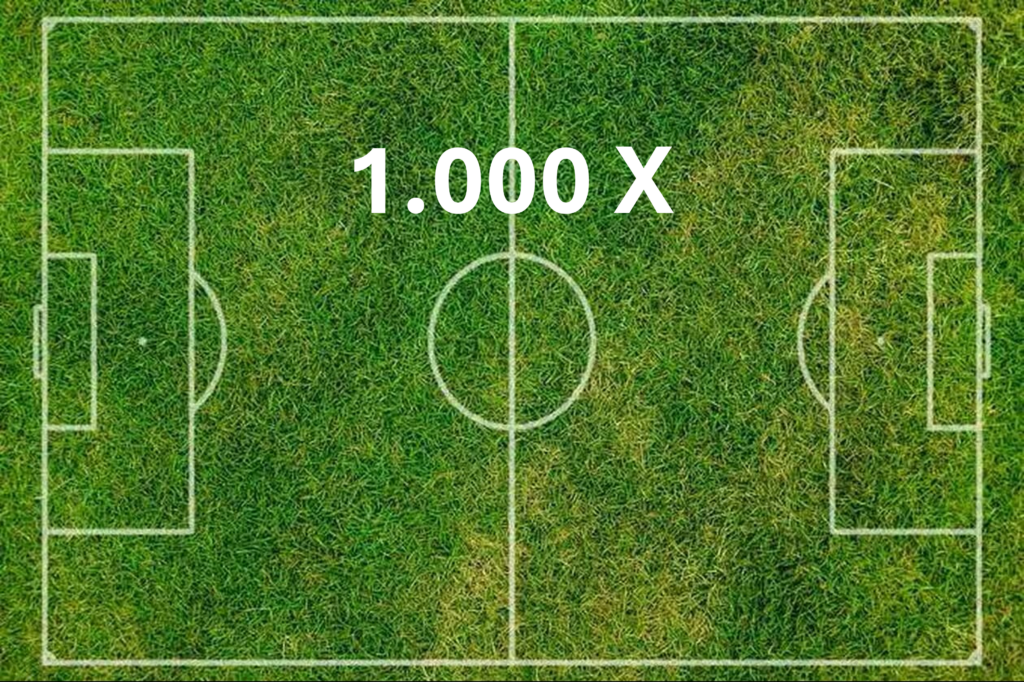
The activated carbon from coconuts in the Biofilter, mixed with the hollow fiber, provide an adsorption surface equivalent to 1,000 football fields !!! (3,000 m2/g of activated carbon x 3 Kg)